
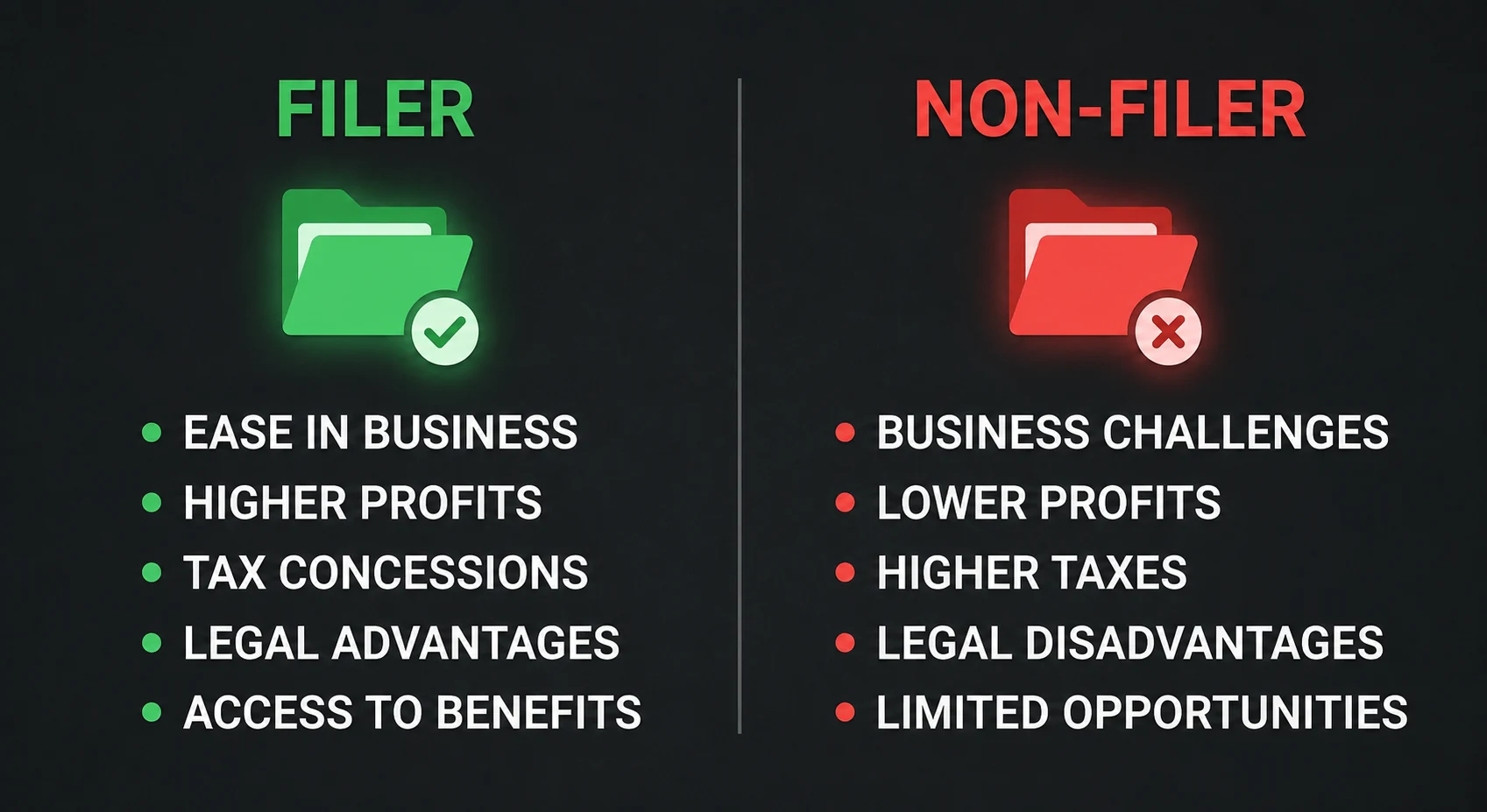
Every year, millions of Pakistanis lose a lot of rupees without realizing it. They lost this money simply because they never registered as a tax filer. The terms "filer" and "non-filer" get thrown around a lot. However, most people do not understand what they mean. They do not know how much money is at stake. This guide breaks down the filer vs non filer status in Pakistan in simple terms. You will learn what it means and how the FBR treats each category. You will see exactly how much more a non-filer pays on everyday transactions.
What Does "Filer" Actually Mean?
A filer is someone who registers with the Federal Board of Revenue (FBR). This person files their income tax return on time. Their name appears on the Active Taxpayer List (ATL). The FBR publishes and updates this list regularly on its public portal.
A non-filer is different. This term refers to someone who does not file a tax return at all. It also includes people whose names do not appear on the ATL for the current tax year.
The Two Categories You Need to Know
Pakistan's tax system recognises two main statuses for withholding tax purposes:
Status | Definition | Tax Treatment |
Active Filer | Filed return before the deadline, appears on ATL | Lowest tax rates |
Non-Filer | Has not filed a return at all | Highest tax rates |
Note: If you miss the filing deadline, you can still restore your active status by paying the ATL surcharge (see below). Once restored, you're treated as an active filer going forward — but late filing does carry a real financial penalty, so filing on time is always the cheaper option.
How to Check Your Filer Status?
Checking your status takes less than a minute:
SMS method: Send your 13-digit CNIC number to 9966. You'll receive an instant reply showing your ATL status.
Online method: Visit fbr.gov.pk, go to the Online Verification Portal, select "ATL (Income Tax)," and enter your CNIC or NTN.
If your status shows "Active," you're a filer. If not, it's time to take action.
The Real Cost of Being a Non-Filer
This is where most people are genuinely shocked. The gap between filer and non-filer tax rates isn't small. It can run into hundreds of thousands of rupees on a single transaction.
Property Transactions
Property is where the difference used to hit hardest. Under Section 236C (property sale) and Section 236K (property purchase), rates were previously slab-based and varied by filer status. Under the Finance Bill 2026, this has changed significantly: both sections now apply a uniform advance tax rate regardless of filer status.
Transaction | Rate (Finance Bill 2026) |
Property Sale (236C) — Sellers | Uniform 2.75% |
Property Purchase (236K) — Buyers | Uniform 1.25% |
Note: These are the rates proposed under the Finance Bill 2026, replacing the earlier slab-based, filer-status-dependent rates. Rates and their final applicability can still change until the Bill is passed. Always verify current rates at fbr.gov.pk before any transaction. So if you're buying a property worth Rs. 1 crore, the advance tax works out to around Rs. 1.25 lakh under the new uniform rate, regardless of whether you're a filer or non-filer. In 2026, this is one of the biggest shifts in how property transactions are taxed in Pakistan.
Bank Transactions
Bank profit tax is 15% for filers and 35% for non-filers. That alone is more than double on every rupee of interest you earn.
Cash withdrawals are also affected. According to recent FBR data, withholding tax on cash withdrawal is levied at 0.6% for non-filers compared to 0% for active filers on withdrawals above Rs. 50,000.
Vehicle Registration
Non-filers pay double tax across every vehicle engine category when registering a new car. If you're planning to buy a 1300cc or above vehicle, this difference alone can add a significant amount to your total cost.
Dividend Income
Your dividend income faces different taxes depending on your status if you invest in stocks or mutual funds. Active filers typically pay a standard 15% rate. Non-filers pay considerably higher rates. This tax sometimes reaches 25% or more, depending on the income bracket.
Capital Gains on Property
The rules around capital gains tax changed significantly in mid-2024. Active filers now pay a flat rate on profit from property sales, while non-filers face a sliding scale that climbs much higher depending on income level, making it one of the costliest areas to ignore filer status.
Why Does the Government Charge Non-Filers More?
This isn't random. It's a deliberate FBR policy. Non-filers face higher withholding rates as a deliberate FBR policy to push people into the tax net. In other words, the higher rates aren't just a penalty. They're designed as an incentive to make people register and start filing.
Pakistan has historically struggled with a narrow tax base, meaning a relatively small number of people pay most of the country's direct taxes. By making non-filer status financially painful, the FBR is trying to widen that base year after year.
Beyond Tax Rates: Other Consequences of Being a Non-Filer
Higher withholding tax is just one part of the picture. Staying off the Active Taxpayer List creates problems that go beyond your tax bill.
Loan and credit card rejections. Banks are far less likely to approve financing for individuals who don't appear on the ATL, since filer status acts as a basic trust signal.
Reduced business credibility. Many government contracts, tenders, and business registrations require an active filer status as a mandatory condition.
No access to government schemes. Subsidised loans, relief packages, and support programs are typically restricted to active filers only.
Greater scrutiny and audit risk. Non-filers are more likely to attract FBR attention, especially for high-value transactions like property or vehicle purchases.
SIM and utility restrictions. In some enforcement drives, FBR has worked with telecom regulators to flag or restrict services for chronic non-filers.
How to Become a Filer And Fix Your Status?
Becoming a filer is completely free. You can be done entirely online through the FBR's IRIS portal. Here's the short version:
Register on iris.fbr.gov.pk using your CNIC.
Complete your profile with accurate personal and financial details.
File your income tax return for the relevant tax year.
Submit a wealth statement alongside your return.
If you missed the deadline, pay the ATL surcharge to restore active status. Under the Finance Bill 2026, the surcharge is proposed to increase substantially: Rs. 25,000 for individuals (up from Rs. 1,000), Rs. 50,000 for Associations of Persons/AOPs (up from Rs. 10,000), and Rs. 100,000 for companies (up from Rs. 20,000). Until the Bill is passed, the existing lower rates apply. Always confirm the current surcharge at fbr.gov.pk before paying.
Once your return is processed, your name typically appears on the ATL within a few days to a week.
Missed the Deadline? Here's What It Costs You
A common mistake people make is assuming that filing a few days or weeks late makes no real difference. It does. Filing after the deadline means paying the ATL surcharge before your name is restored to the Active Taxpayer List — and under the Finance Bill 2026, that surcharge is set to rise sharply, as shown above. Filing on time avoids this cost entirely, while staying a non-filer altogether means paying the maximum withholding rates across the board with no easy fix.
You must file your return as soon as possible and pay the surcharge if you missed this year's deadline. This approach is the smartest move for your finances. Do not remain a non-filer for the rest of the tax year.
Final Thoughts
The difference between filer and non-filer status in Pakistan is not just a technical label. It is a financial decision that affects nearly every major transaction. Registering and filing is free, fast, and fully online. Staying a non-filer is one of the most expensive habits a Pakistani taxpayer can have.
Disclaimer: Tax rates and rules in Pakistan change through annual Finance Acts. The Finance Bill 2026 figures referenced above are proposed amendments and may be revised before final passage. Always confirm current rates through the official FBR portal at fbr.gov.pk before making financial decisions.
FAQs
Can overseas Pakistanis avoid filing but still get filer rates?
Yes, they can. Overseas Pakistanis who invest through a Roshan Digital Account receive full and final tax treatment. They do not need to file a standard return. They can also apply for an exemption certificate from the Commissioner of Inland Revenue.
How long does it take to become an active filer after submitting a return?
This process usually takes a few days. Sometimes, it takes up to a week because FBR processing times vary.
Does being a non-filer mean I am doing something illegal?
Failure to file a return is a compliance violation. It is not a criminal offense on its own. This delay exposes you to penalties, audits, and higher tax rates.
Is there any benefit to staying a non-filer?
Practically, no. The cost of non-filer status almost always exceeds the effort you need to file a return. The digital IRIS portal makes the entire process very simple.