
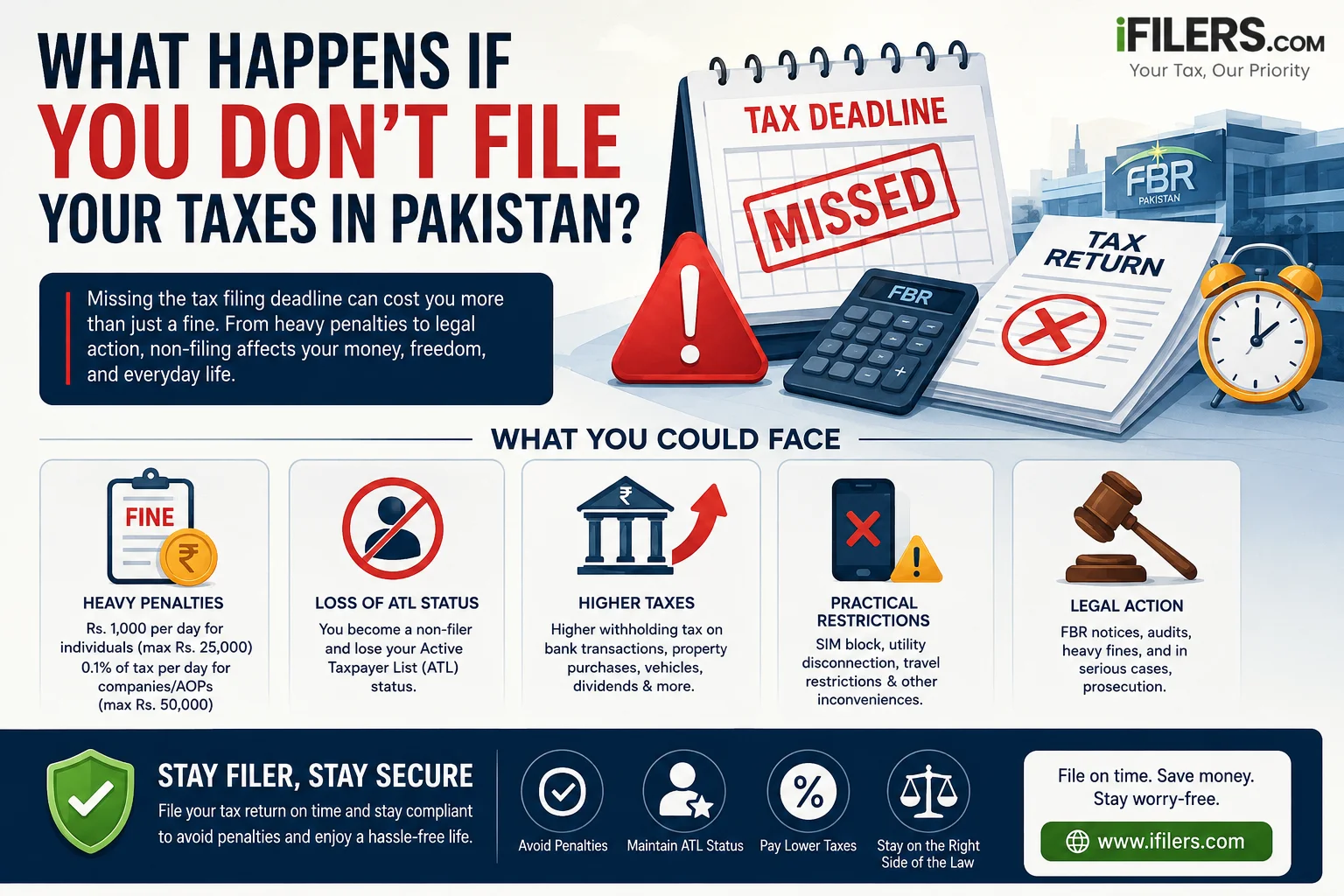
If you don't file your income tax return in Pakistan by the FBR deadline, you become liable for a penalty under Section 182 of the Income Tax Ordinance, 2001. Under the updated regulations, the specific daily accruals depend entirely on the type of taxpayer: individuals face a fine of Rs. 1,000 per day overdue (capped at Rs. 25,000). At the same time, companies and AOPs are charged 0.1% of the tax payable per day (capped at Rs. 50,000). But the fine is really just the opening cost. Once your name is removed from the Active Taxpayer List (ATL), you start paying significantly higher withholding tax on almost every major transaction you make, from bank withdrawals to property transfers. In more serious cases, FBR can restrict your SIM card, flag you for an audit, or pursue legal action.
For a country still working to widen its tax base, FBR has made non-filing an increasingly expensive and inconvenient position to be in. Here's a complete breakdown of what actually happens when you skip your tax return, and why the consequences reach much further than most people expect.
What Non-Filing Actually Costs You
Consequence | What It Means |
Direct FBR Penalty | Rs. 1,000/day for individuals (cap Rs. 25k) or 0.1%/day for companies/AOPs (cap Rs. 50k) |
Loss of ATL Status | Reclassified as a non-filer across all financial systems |
Higher Withholding Tax | More tax on bank transactions, property, vehicles, and dividends |
Practical Restrictions | Possible SIM block, utility disconnection, travel limits |
Legal Exposure | FBR notices, audits, and in serious cases, prosecution |
Who Actually Needs to File a Return?
Filing isn't optional for most working adults in Pakistan. FBR generally expects a return from you if you:
Earn a taxable salary or business income
Own property above a certain value
Hold a registered vehicle
Have travelled abroad during the relevant tax year
Are you an overseas Pakistani with local income sources
Even taxpayers with no income to declare are often required to submit a nil return, simply to stay compliant and retain their filer status.
The Direct Financial Penalty
Under Section 182, missing the filing deadline triggers specific daily fines and maximum limits based on the exact statement missed:
Late Income Tax Return (Individuals): Rs. 1,000 per day overdue. The maximum cap is Rs. 25,000.
Late Income Tax Return (Companies or AOPs): 0.1% of the tax payable per day. The maximum cap is Rs. 50,000.
Late Wealth Statement (Section 116): Rs. 100 per day overdue. There is no maximum limit for this specific penalty.
Late Withholding Tax Statement (Section 165): Rs. 2,500 per month overdue. The maximum cap is Rs. 50,000.
Additionally, the "tax payable" baseline for these percentages is tied to the higher of the current assessment year's liability or the highest tax payable in any of the three immediately preceding tax years.
Other Major Section 182 Penalties
Section 182 also levies fixed penalties for procedural or transparency non-compliance:
Failure to Register for NTN: A flat penalty of Rs. 5,000.
Providing False or Misleading Information: A minimum penalty of Rs. 25,000, which scales higher based on the financial severity of the case.
Non-Compliance with Audit or Inquiry Notices: Fixed statutory fines that scale upward for repeated offenses.
Notice Requirements: Before these fines are finalized, the FBR issues a formal Section 182 Notice via the FBR IRIS Portal. Taxpayers are typically given 7 to 15 days to respond.
Losing Your Active Taxpayer List (ATL) Status
Filing on time is what keeps your name on FBR's Active Taxpayer List, and this list matters more than most people realize. It's the single biggest factor determining how much tax you pay on everyday financial activity throughout the year. Fall off the ATL, and you're reclassified as a non-filer immediately, well before FBR ever issues a notice or penalty against you directly.
Paying More for Ordinary Transactions
This is where non-filing becomes expensive in a way that touches daily life, not just tax season. Compared to active filers, non-filers typically pay more on:
Bank transactions and cash withdrawals above certain limits
Dividend income and profit on debt
Vehicle purchase and registration
Property transactions ( both buying and selling )
Property transactions have seen significant structural rationalization. Instead of older slab systems, sellers now face a uniform advance tax rate of 2.75% under Section 236C, while buyers face a uniform rate of 1.25% under Section 236K. Furthermore, the enhanced-rate categorization for "late filers" under the Tenth Schedule has been abolished. However, non-filers still face steep withholding rates on real estate deals, and if a non-filer purchases a high-value property, FBR can ask them to prove the source of funds, with severe penalties if they can't.
Note: The previous tax on deemed income under Section 7E has also been completely omitted. For anyone buying a home, importing goods, or simply managing routine banking, filer status directly affects the final bill.
Beyond Money: Practical Restrictions
FBR's enforcement powers extend past financial penalties. Tax authorities have the legal ability to:
Disable the mobile SIM connections of confirmed non-filers
Coordinate with telecom regulators to enforce this at scale
Discontinue utility connections for chronic non-compliance
Apply travel restrictions in persistent non-filing cases
With FBR's digital systems now cross-checking CNIC records against national databases in real time, non-filers are identified automatically rather than manually, which has made these restrictions far easier for the authority to enforce.
Notices, Audits, and Legal Exposure
Non-filing doesn't just sit quietly in the background. FBR can issue a formal notice requiring anyone missing from the ATL to file a return, and ignoring that notice escalates things considerably. Persistent non-filers face a higher likelihood of being selected for audit, and if FBR believes income has gone undeclared, it can proceed with its own assessment of what it estimates you owe, rarely a favorable outcome compared to filing accurately yourself.
In serious or repeated cases of non-compliance, the law also allows for prosecution, carrying the possibility of a fine, imprisonment of up to one year, or both, alongside the standard financial penalties.
What If You've Already Missed Several Years?
Falling behind on multiple years of filing doesn't mean accepting non-filer status indefinitely. Pakistan's tax law generally allows returns to be filed, or revised within five years, and catching up resolves your ATL standing and stops the compounding cost of non-filer treatment on future transactions. The longer the gap stays open, the more it costs in higher withholding rates and lost opportunities. Addressing back returns sooner almost always works out cheaper than waiting.
Getting Back on Track
Fixing non-filer status is usually simpler than people assume:
File your return through FBR's online IRIS portal
Pay the ATL surcharge if you've missed the deadline
Your filer status is typically restored within 24–48 hours of payment confirmation
However, clearing your name and getting back onto the ATL after missing the due date has become significantly more expensive. The surcharge has been heavily enhanced and is now Rs. 25,000 for individuals (up from the previous Rs. 1,000), Rs. 50,000 for Associations of Persons (AOPs), and Rs. 100,000 for companies. Salaried individuals with straightforward income can often complete the filing process the same day, but given the steep cost of late-filing surcharges and historical penalty tracking, working with a tax consultant is highly recommended to avoid errors.
Conclusion
Skipping your tax return in Pakistan rarely ends with just a missed deadline. Between the direct FBR daily penalties, a steep Rs. 25,000 ATL reinstatement surcharge for individuals, higher withholding tax on nearly every transaction, and the possibility of audits or legal action, non-filing tends to cost far more over a year than the return itself would have taken to complete. Filing on time, even a simple nil return, remains the more affordable choice by almost every measure.
Frequently Asked Questions
What is the minimum penalty for not filing taxes in Pakistan?
For individuals, late return submission triggers a daily penalty of Rs. 1,000 up to a maximum cap of Rs. 25,000. For companies and AOPs, it is calculated at 0.1% per day up to a maximum cap of Rs. 50,000.
Do I still need to file if I have no taxable income?
Yes. A nil return is typically required to maintain your NTN registration and ATL status, even with zero declared income.
Can non-filer status affect buying a property?
Yes, significantly. While standard transactions now follow uniform rates (1.25% for buyers and 2.75% for sellers), non-filers face much higher withholding penalties and strict asset evaluation by the FBR on high-value purchases.
How long can I go back and file missed returns?
Returns can generally be filed or revised within five years, after which FBR's active assessment period typically closes.